 Aspiring harmonica players should
start with a standard 10-hole diatonic harmonica in the key of C.
Most instructional books and videos will assume that "C" is the key you
are using. Aspiring harmonica players should
start with a standard 10-hole diatonic harmonica in the key of C.
Most instructional books and videos will assume that "C" is the key you
are using.
Consider a harmonica with a plastic comb. While many professional
players have traditionally performed on wood-comb harmonicas, more are
using plastic as time goes by. Plastic is a much more constant medium
and requires less maintenance. Plastic combs will not swell from
moisture, are less abrasive on your lips, and more airtight for greater
volume. So, unless you're set on one of the classic wood-comb
harmonicas, like the Hohner Marine Band or Hohner Blues Harp, start with
plastic.
 Learn to play on a budget Learn to play on a budget
The
choices are easy if you're going for an inexpensive harmonica --
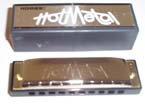
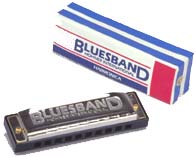
anything under $20, like the Hohner Hot Metal or Hohner Blues Band. Made in the Orient, these harmonicas are perfect for
beginners
of any age. You'll be amazed at the big blues sound they deliver.
Learn to play on a professional harmonica
If you're of a more serious mindset despite being a raw
beginner, the good news is that even an artist-level 10-hole diatonic
harmonica is not that expensive when compared to most other
instruments. Pro harmonicas like Hohner and Lee Oskar cost $40 and up. These instruments have better tone, tuning, and
longer life than their cheaper cousins. And pro harmonicas are manufactured in
all keys.
 Check out the Hohner
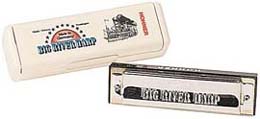
Big River Harp, the Hohner Special 20, and the Lee Oskar Major Diatonic. Check out the Hohner
Big River Harp, the Hohner Special 20, and the Lee Oskar Major Diatonic.
The Big River
Harp is attracting the attention of pro harmonica players. It's Hohner's least-expensive German-made model.
It seems to have the life expectancy of the Special 20, yet it's several
dollars cheaper. The contour of the cover is somewhat higher than
Hohner's other models, giving the Big River a thick profile that's easy
to hold. And it has the advantage of replaceable reed plates,
which is a money-saving alternative to throwing away an out-of-tune
harmonica.
 The
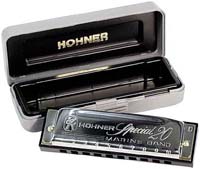
Special 20 is
our favourite Hohner diatonic for price and quality. It's also the first
choice of demanding players like Blues Travellers' John Popper. If you look closely at the
cover plate, you'll see the "Marine Band" inscription in small letters. Therein lies an explanation
for its broad appeal: it has the reeds, tone, and feel that closely
resemble the world-famous wood-comb Hohner Marine Band. However, the
Special 20 has the advantages of a plastic comb. Why not make it
your first choice? The
Special 20 is
our favourite Hohner diatonic for price and quality. It's also the first
choice of demanding players like Blues Travellers' John Popper. If you look closely at the
cover plate, you'll see the "Marine Band" inscription in small letters. Therein lies an explanation
for its broad appeal: it has the reeds, tone, and feel that closely
resemble the world-famous wood-comb Hohner Marine Band. However, the
Special 20 has the advantages of a plastic comb. Why not make it
your first choice?
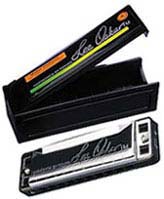 The serious beginner can't go wrong with a
Lee
Oskar Major Diatonic, the choice of many pros for playing blues,
rock, folk, jazz, and country. Constructed with a plastic comb and
replaceable reed plates, this harmonica's durability and tone are renowned. The serious beginner can't go wrong with a
Lee
Oskar Major Diatonic, the choice of many pros for playing blues,
rock, folk, jazz, and country. Constructed with a plastic comb and
replaceable reed plates, this harmonica's durability and tone are renowned.
|