When
reading about or talking about amplifiers, you're going to hear
about the three
main parts: preamp, power amp, and
speaker(s). These can be purchased as individual components or in
a convenient package known as a combo amp.
- preamp -- this receives the signal from your
electric instrument and then lets you shape its tone through equalization and other effects. The effects
available depend on the model of amplifier. Control
knobs associated with the preamp include Gain (or Pre Gain),
Treble, Middle, Bass and Reverb.
- power amp -- this takes the weak signal (with the
shaped tone) from the preamp and turns it into a stronger
signal with enough power to send it to the speakers. The power
amp determines how loud the overall sound will be. Power is
expressed in watts; the more watts, the more power and the
louder the amp. If you're a beginning player, a small practice
amplifier with 10 to 30 watts is all you need. Guitar stage
amplifiers usually begin above 30 watts and reach 250 watts or more. The power amp is controlled by the Volume
control
knob on the amplifier (it may also be called Master, Post
Gain,
Level, or Master Volume).
- speaker(s) -- the speaker cabinet (or enclosure) houses the
speakers. Average speaker sizes for an
electric instrument are 8, 10, 12, 15, or 18 inches. In general, larger speakers mean that your sound
can have more bottom end (deeper tones). An amp can have one
or more speakers. For your first amp, a single 8- or 10-inch speaker will deliver enough sound for
practicing.
Combo Amp
This is the most common amplifier used by beginners and
professionals in practice, studio, and stage
situations. In a combo amp, the speaker cabinet is the enclosure
that houses the speaker(s), the preamp and the power amp. Smaller combo amps often have an open cabinet
back creating a louder, more resonant sound. Larger combo amps
are usually sealed, providing more focused projection and better
bass response.
Head and Cabinet Amps
In this configuration, the
speaker cabinet contains only the speaker(s) while the preamp
and power amp are combined into a unit referred to as
the "head." The head usually sits on top of the
speaker cabinet. Some players like the separate components because
it gives them the flexibility to individually select and match
the speaker cabinet to the head. Others find them too hard to
lug around. A head combined with a cabinet containing four
12-inch speakers is called a "half stack" (shown in
the picture). Two of
these make a "full stack."
|
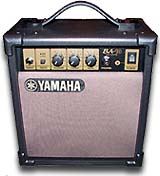
10 watt Combo Amp
with a single
8-inch speaker
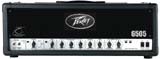
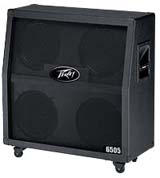
Head and Cabinet Amp |
|